
You've heard you shouldn't microwave a bottle. But the microwave is right there, and 30 seconds feels harmless. You shake it hard, test a few drops, and hope. Here's what's actually happening inside that bottle, and how to make the microwave something you never need.
Can you microwave formula? It heats in hot spots.
The CDC's rule is plain: if you warm your baby's bottle, never use a microwave.1
Microwaves don't heat evenly. The CDC says they leave hot spots that can burn a baby's mouth and throat.1
Here's the part fewer parents hear: warming is optional. The CDC says infant formula doesn't need to be warmed before feeding.1 But if your baby only takes it warm, that fact doesn't help much.
What the CDC says to do instead.
- Run it under warm water. Hold the bottle under running warm water, and keep water from getting into the bottle or on the nipple.1
- Test a couple of drops on your wrist. It should feel warm, not hot.1
Premixed bottles go bad after just 2 hours.

Out of the house, most parents premix before they leave.
That works for a while. The CDC says to use a mixed bottle within 2 hours, and within 1 hour once your baby starts drinking.1 Keep it in the fridge and it lasts 24 hours, but now it's cold, and you're looking for a way to warm it again.
Here's why that limit matters. According to the World Health Organization, bacteria multiply fast in formula left out at room temperature.2 That raises the chance of an upset tummy: more spit-up and messier diapers. This is also the advice in the UK, from the National Health Service: make up each feed as your baby needs it.3
Mix it fresh, and skip the reheat.
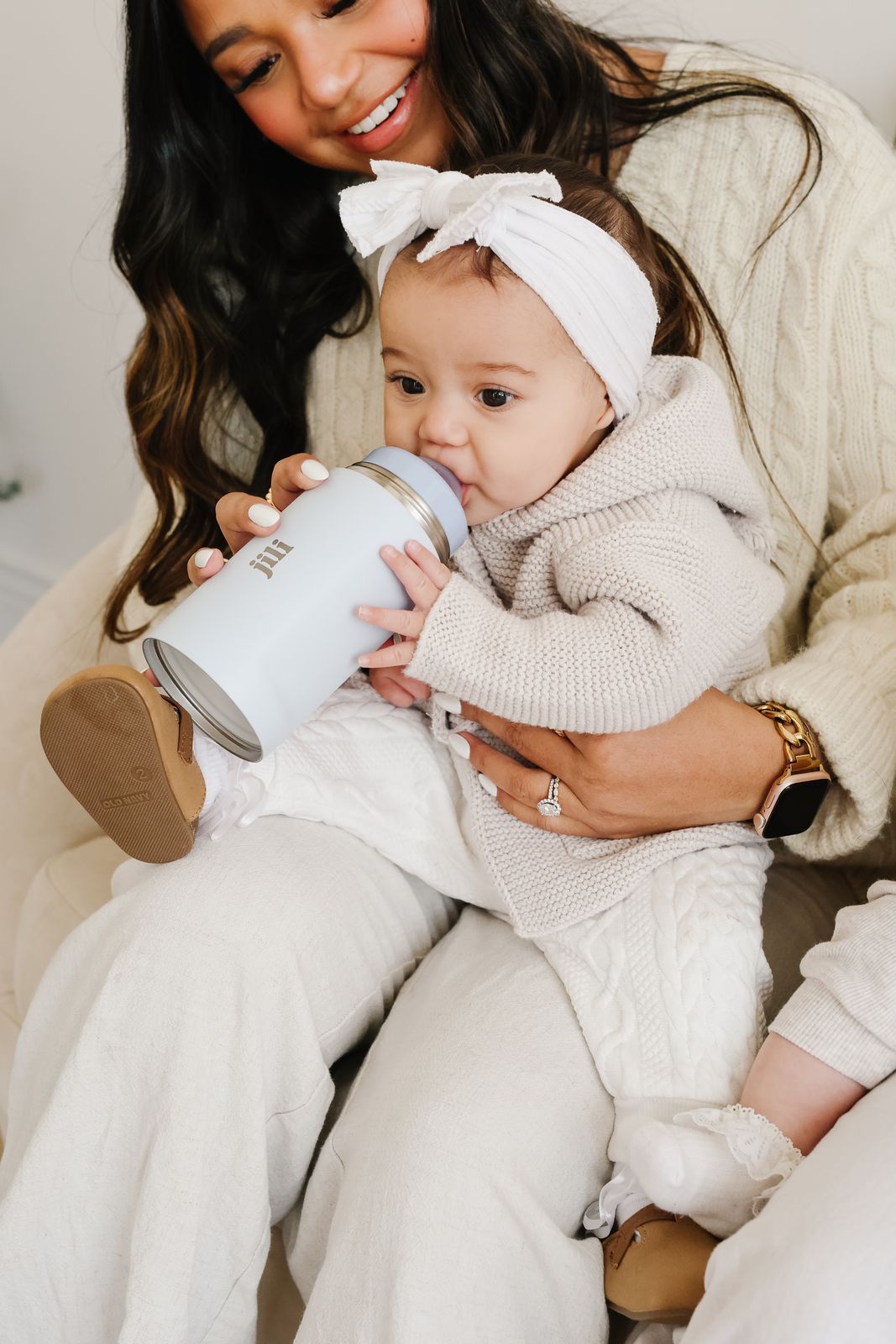
The fix is to keep the formula and the warm water apart until your baby's hungry. That's what Jili was built for.
The formula waits dry in the base. Hot water waits in 18/8 stainless steel, so it never sits in heated plastic. When your baby's ready, pour the formula in, shake, and feed. That bottle was mixed a minute ago, so you get the CDC's full 2 hours.
The water stays warm for 8 hours, so there's nothing to microwave and no cafe to ask for hot water.4
Mixing each bottle fresh, right when your baby's hungry, is just what the World Health Organization recommends,2 and it keeps every bottle inside the CDC's 2-hour window.1
Jili keeps the formula dry in the base until your baby's hungry, so the bottle you shake at the park is as fresh as one made at home.
Shop Jili · $45- Centers for Disease Control and Prevention. Infant Formula Preparation and Storage (opens in a new tab). Accessed October 2026.
- World Health Organization and FAO. Safe preparation, storage and handling of powdered infant formula: guidelines (opens in a new tab). 2007. Accessed October 2026.
- National Health Service (NHS), UK. How to make up baby formula (opens in a new tab). Accessed October 2026.
- Jili. All-In-One Baby Bottle: product details. Accessed October 2026.
- Li, D. et al. Microplastic release from the degradation of polypropylene feeding bottles during infant formula preparation (opens in a new tab). Nature Food, 2020. Accessed October 2026.